

Photoperiod cannabis plants rely on changing light cycles to flower, giving growers more control and higher yields. Autoflowers, on the other hand, bloom based on age, offer faster harvests and are easier care. Each suits different grower goals, space, and experience levels.
Let’s find out which cannabis type fits your grow style.
Why You Need the Right Cannabis Type for Your Grow
Most grow failures don’t come from bad genetics. They come from planting the right strain in the wrong setup. Before you worry about THC percentages or flavor profiles, lock in the fundamentals:
Grow Space
Photoperiods need more room and precise light control. These plants stretch tall, respond to training, and rely on strict 18/6 and 12/12 lighting. That requires a blackout grow tent or a dedicated indoor room. Any light leak can disrupt flowering or trigger re-veg.
Autoflowers thrive in tighter spaces. They don’t need light schedule changes to flower, so they do well in closets, balconies, greenhouses, or tents with ambient light. If space is limited, or your grow area isn’t fully sealed, autoflowers give you more flexibility.

Experience Level
Photoperiods offer margin for error. A mistake in week two can be corrected in veg before flipping to flower. This makes them valuable tools for growers who want to train plants, dial in feeding regimens, or experiment with advanced techniques.
Autoflowers are less forgiving. Their internal clock starts the moment they sprout, and stress during early veg can permanently affect size and yield. They demand a stable setup right from the start. If that’s in place, they deliver consistent results fast.
Goals
Speed or scale. Simplicity or precision. That’s the real fork in the road.
If your goal is a quick, personal stash with minimal maintenance, autoflowers are a smart pick. They finish fast, don’t need training, and can produce solid results with basic care.
If your goal is high yield, rich flavor, or strain preservation, photoperiods are the tool. They allow cloning, longer veg times, and full control over when flowering starts. That opens the door to batch timing, SCROG setups, and pheno hunting.
Photoperiod vs Autoflower: The Difference
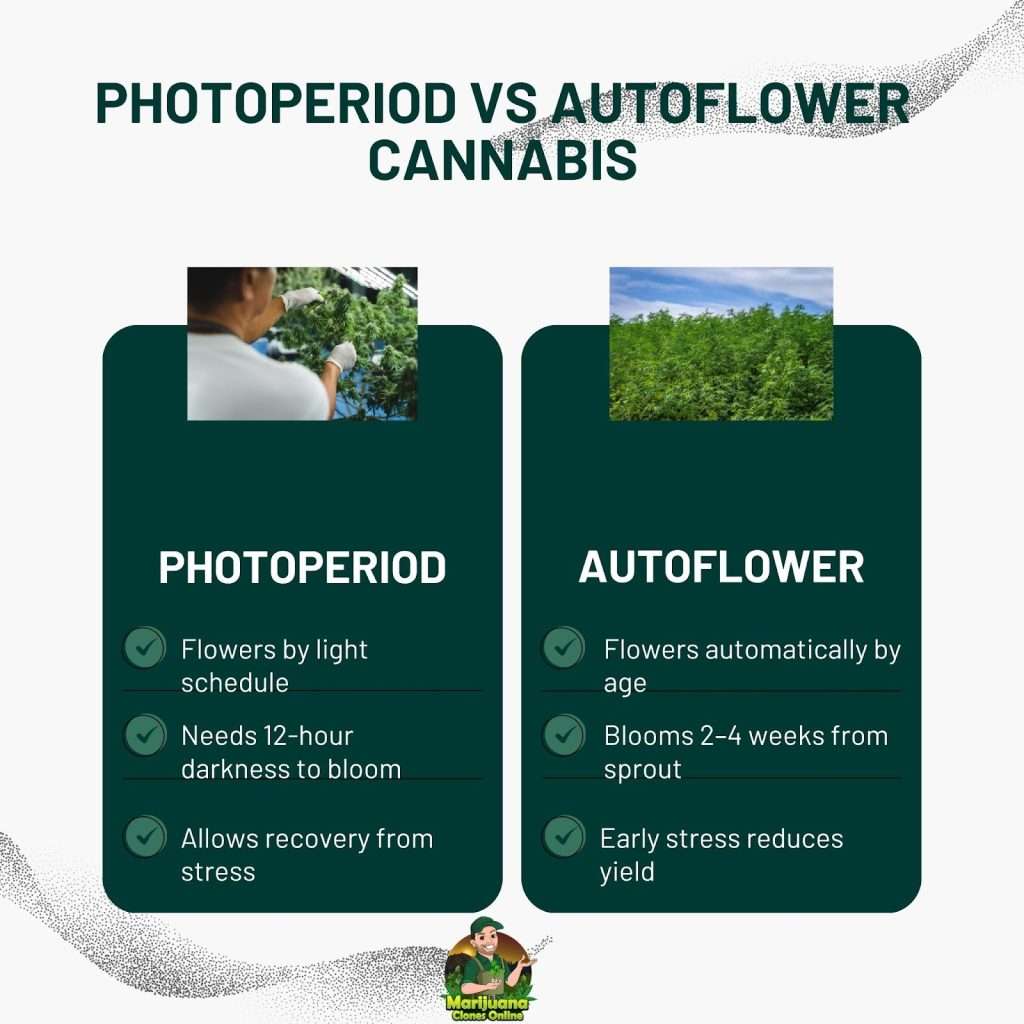
There’s a lot of noise out there about autoflowers being easier or photoperiods being stronger, but what matters is how each one grows. As someone who’s worked with both, I can tell you that they’re different tools for different jobs.
One is not better across the board. You win by knowing how they work, where they shine, and what they demand from you.
Light Requirements & Flowering Triggers
Photoperiod cannabis plants rely on light schedules to tell them when to flower. Keep them under 18 hours of light and they’ll keep growing in veg. Switch to 12 hours of light and 12 hours of darkness, and they’ll start flowering. That control lets you decide exactly when the plant flips. It’s perfect for growers who want to shape their canopy, recover from early mistakes, or run synchronized batches.
Autoflowers don’t care what the light cycle is. They flower based on age, usually within two to four weeks from sprout. You can run them on 18/6 or even 20/4 from start to finish. They don’t need darkness to trigger flower. That’s why they work in places where light leaks are a constant risk. If you’re growing in a room without blackout control, autos won’t flinch.
But that “set it and forget it” style also means you lose flexibility. Once an autoflower starts to flower, there’s no delaying it. You get one shot, and it starts early.
Training & Plant Control
Photoperiods give you the steering wheel. Want to top them? Supercrop? Run a full SCROG canopy? You’ve got time. You can shape and stretch them in veg until every bud site hits the light. If something goes wrong, you can pause, recover, and flip when they’re truly ready.
Autoflowers run on a clock you can’t slow down. Every day in veg is precious. If you stress them early, you don’t get that time back. That’s why high-stress training like topping or fimming usually backfires. Growers who top autos too early often end up with stunted plants and popcorn buds.
Low-stress training (LST) works better. You can gently bend the main stem and guide the branches to open up the canopy. But even that has to be timed right. Too much tension or pressure in week three and the plant may never bounce back.
Nutrients, Cost & Maintenance
Photoperiod plants give you room to dial things in. You can run aggressive nutrient schedules, test organic vs. synthetic blends, or push yield with long veg and rich feedings. If something’s off, you’ve got time to flush, reset, and steer the plant back on track before flowering.
Autoflowers don’t offer that luxury. Their shorter life cycle means nutrient mistakes show up fast, and hit hard. Overfeed in week two and you might never recover. That’s why many growers run lighter nutrient mixes for autos, especially during early veg. Some experienced cultivators get great results with organics, but only when their soil or media is fully tuned. Synthetic nutrients tend to work faster, but they leave less room for error.
Cost-wise, autoflowers can save you money in the short term. They finish quicker, which means fewer weeks of electricity, water, and feeding. You can also run multiple cycles per year, maximizing efficiency in small spaces.
Growth Timeline & Harvest Speed
Photoperiods grow on your schedule. That flexibility lets you run big plants, train them how you want, and flip them into flower only when they’re dialed in and ready. Once flipped, flowering takes another 8 to 10 weeks, depending on the strain.
Autoflowers don’t wait for anyone. Most go from seed to harvest in 8 to 10 weeks total, sometimes less. That makes them ideal for fast personal runs or growers who want to squeeze in multiple harvests per season.
But speed comes at a price. If your autoflower stalls in early veg, it’ll still flower on schedule. That’s where you get those tiny, underwhelming plants with under 2 feet of height and disappointing yield. A lot of growers hit that wall and wonder why their auto didn’t stretch.
Photoperiods offer recovery time. You can grow them slow and steady or push for aggressive cycles. Autoflowers give you speed, but they demand perfection early on. The harvest clock starts the moment they sprout, and there’s no pause button.
Yield Potential
Photoperiod plants are the heavy lifters. When given the time and space, they reward growers with big yields. Also, you can veg longer, train wider, and stack bud sites before triggering flower. That control adds up to serious volume if you know how to use it.
Autoflowers cap out lower, usually between 1 to 4 ounces per plant in ideal conditions. Some growers do break the 4-ounce mark, but it’s rare and takes a perfect run. If you’re expecting a huge haul from autoflowers, you need everything dialed in from day one.
Potency & Resin Quality
Photoperiod strains have long been the standard for top-shelf potency and resin production. That’s because breeders have had decades to refine these genetics for flavor, strength, and bag appeal. When grown well, photoperiods consistently deliver rich terpene profiles, thick trichome coverage, and effects that hit hard and linger.
Autoflowers have come a long way. Early versions were low-THC and lacked flavor complexity. But modern autoflowers can rival photoperiods in potency, often testing above 25% THC. Still, many experienced growers notice that even strong autos feel a bit lighter in the effect, and often fall short on resin output for concentrates or full melt.
So, Which One Is Better for You?
The voice is not about which type is better, but what you want from your grow.
If you’re after speed, simplicity, and a low-maintenance setup, autoflowers can take you from seed to harvest in under 10 weeks. They don’t care about light cycles, they thrive in small spaces, and they’re perfect for growers who want quick results without fuss.
If you want control, heavy yields, and the ability to shape your grow from start to finish, photoperiods are the move. You can clone them, train them, and run them like a pro. You decide when they flower, how they grow, and how far you push them.
Ready to Grow?
Explore our exclusive photoperiod clones shipped to your door, fully rooted and ready to flip when you are.
Want to just skip the whole growing process and have premium, California grown THCa flower shipped straight to your door? We offer THCa flower quarter pounds, THCa Ounces and so much more!